
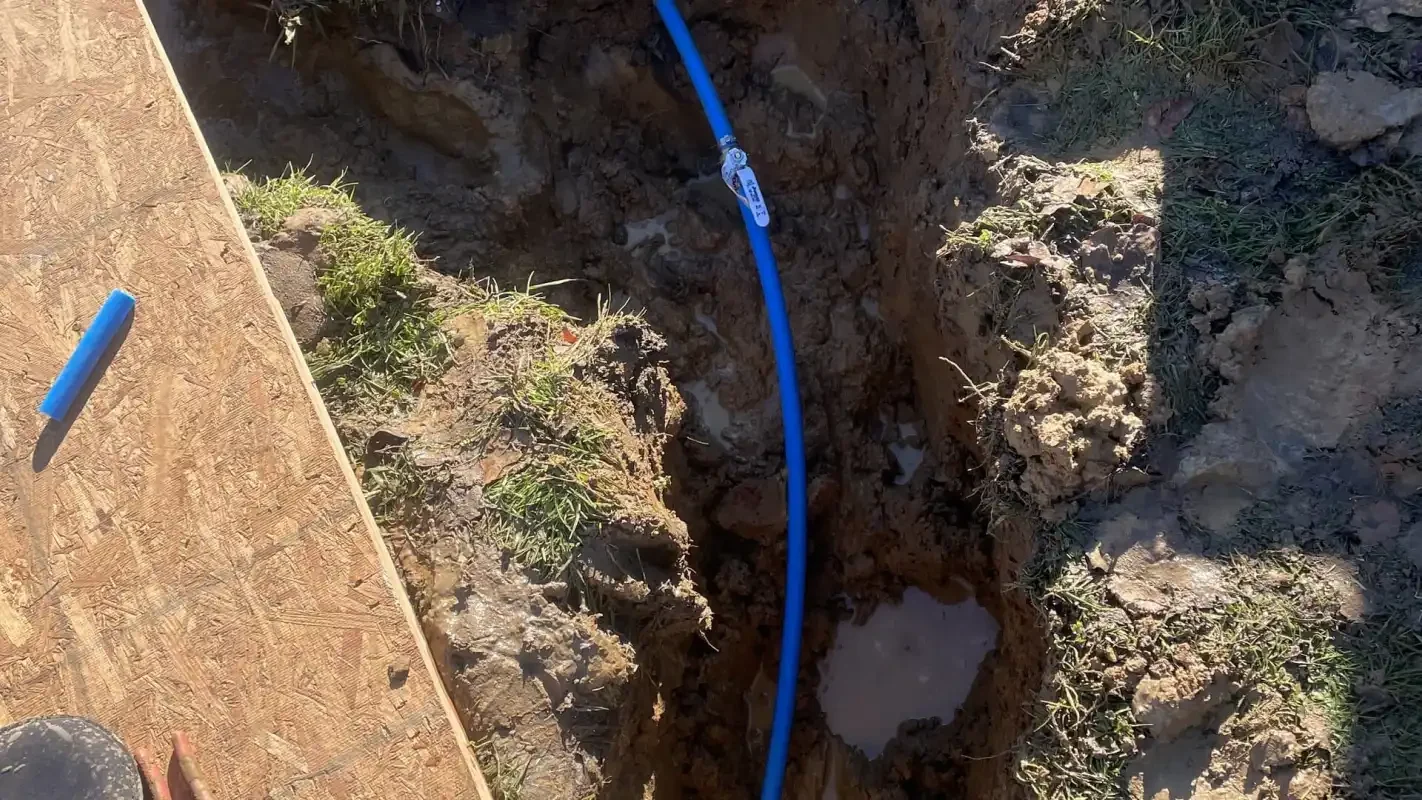

Water Service Line in Pilot Point.
Every drop the house uses comes through one buried line from the meter or the well. In Pilot Point that line can be a short stretch of pipe across a town lot or a long run over acreage that feeds a barn and a yard hydrant along the way. When it leaks, it rarely leaks where anyone can see.
How a service line tells you it is leaking
A leak in the service line almost never shows up as water inside. It shows up in the yard, and it takes its time. Most people notice the lawn before they notice the bill.
The first sign is usually a patch of grass that stays wet, or greener than the lawn around it, days after the rest has dried out. The meter is the next thing to look at. Turn off every tap, the ice maker and the sprinklers, then watch the dial for a few minutes; if it keeps creeping, water is leaving somewhere between the meter and the house. Pressure that has fallen at every fixture at once points the same way. Neither test costs anything to try.
If the meter moves while every tap in the house is off, that water is going somewhere.
On a well there is no meter to watch, so the clue is the pump kicking on when nobody is running water. Whichever one you have, the leak gets located along the line before any digging starts, because a trench opened in the wrong spot only buys you a second trench. A+ comes up US 377 from Krugerville through Aubrey to reach Pilot Point, so if the yard is wet and the meter is moving, (940) 231-5706 is a reasonable first call.
Short runs in town, long ones on the acreage
The houses closest to the old downtown square are generations older than the new streets on the edges of town, and their service lines tend to be as old as the houses.
Those runs are usually short, but they may be galvanized steel or an early plastic that has been in the ground far longer than anyone intended. Out on the acreage around Pilot Point it is a different job. The meter or the well can sit a long way from the house, and the line rarely stops at the back door. It tees off to a barn, a shop or a frost-free hydrant in the yard, and each branch is another joint that can fail and another stretch that can freeze in a hard February.
Length changes the decision. A long line has more joints, and when one fails it is fair to ask whether the line has one bad section or is simply worn out end to end. Sometimes the right answer is a patch, and sometimes it is a new line. The other half of doing it right is the sod: it gets cut and rolled back beside the trench so it goes back down when the trench is filled, instead of disappearing into the backfill. The water service line page covers the general version of all this.
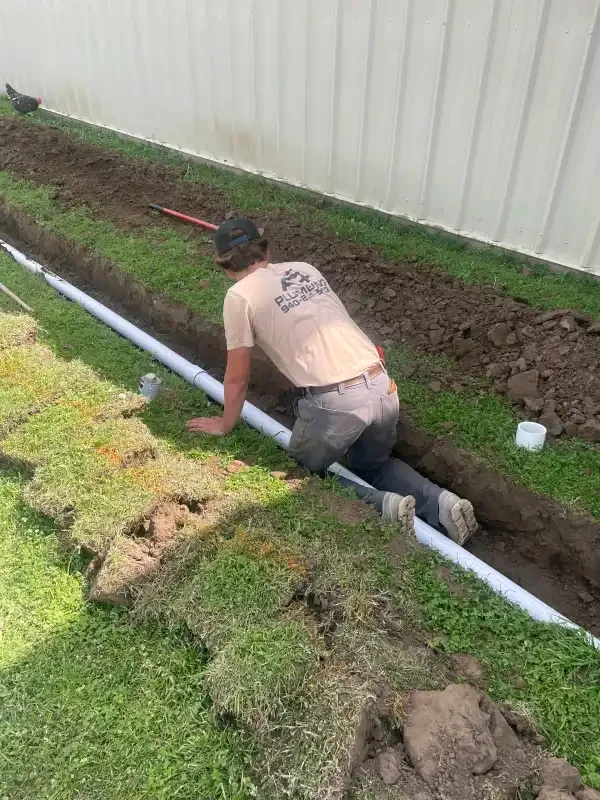
Patch one section or replace the run
Galvanized in the oldest houses
Steel supply rusts from the inside, so the pressure fades over years instead of failing in a day. By the time a leak appears, the rest of the pipe is usually narrowed by the same rust.
Gray plastic from the seventies and eighties
The gray poly line from that era tends to let go at its fittings with no warning. When one fitting has failed, the others on the run are the same age and made the same way.
Usually PEX for anything new
New service lines usually go in as PEX. It comes off the roll in long lengths, so a long run across acreage needs very few joints, and it handles a cold snap better than rigid pipe.
When a repair is enough
A younger line with one break, from a shovel, a fence post or a root, can usually be cut out and joined. If the rest of the pipe tests sound, there is no reason to replace it.
Crossing under the driveway
Where the line runs under a driveway, the aim is to get beneath the concrete without breaking it out. If that cannot be done, you hear about it before any saw comes out.
Backfill that stays put
The trench is filled in layers and packed as it goes, so the lawn does not sink into a long groove the first time it rains hard.
The shutoffs nobody tries until they have to
Most houses have a main valve where the service line comes in, and most owners have never turned theirs. When it finally matters, it is often seized solid, and a burst pipe with a valve that will not close becomes a flooded floor while somebody hunts for a meter key. When a service line is repaired or replaced, that valve gets tried, and if it will not shut cleanly it is replaced while the water is already off.
Yard hydrants on the acreage belong in this conversation too. A frost-free hydrant drains itself below ground when it is shut, which only works if it is shut fully and nothing is left hanging on the spout. A hose left connected through a February night is the usual way one cracks.
Pressure gets the same attention. A gauge on an outside faucet takes a couple of minutes and shows whether the new line is delivering what it should, and whether the pressure regulator, where there is one, is doing its job. On a well, the pressure tank comes into that check too. Write in through the contact page with what you are seeing, and include a photo of the meter if you can. Pictures of trench work and new lines are in the gallery.
Other work A+ does in Pilot Point
Gas Line Installation: ranges, grills, shop heaters.
Kitchen Plumbing: sinks, islands, disposals, pot fillers.
Bathtub Installation: freestanding, drop-in and walk-in tubs.
Shower Installation: valves, pans, drains, conversions.
Everything else in town is on the Pilot Point page, and the water service line page has the full write up on this job wherever you are.
Service line questions
How can I tell whether the leak is in the service line or inside the house?
Close the main valve where the line enters the house and watch the meter. If it still moves, the leak is outside, between the meter and that valve. If it stops, the water is going somewhere indoors, and that is a different hunt.
Can you fix just the section that is leaking?
Often, yes. If the line is younger and the rest of it holds pressure, the damaged length gets cut out and joined with new pipe. On old galvanized or gray poly, Norman will tell you plainly if a patch is only buying a few months.
Do you work on lines that come from a well?
Yes. The run from a well to the house is the same kind of job as one from a meter, often longer, and it frequently feeds a barn or a shop on the way. The leak signs differ a little, mainly a pump that cycles when nothing is open.
What happens to my yard?
The sod is cut and rolled back before the trench is dug, then laid back down once the trench is filled and packed. Expect to see a seam for a few weeks while the grass knits back together.
My house has the old gray plastic supply line. Does all of it need to come out?
It is worth planning for, even if it does not all happen at once. That pipe fails at its fittings, and the fittings along one run are all the same age. Norman can look at where it runs and tell you what he would do first if it were his house.
How soon can you get out to Pilot Point?
That depends on the day and what is already booked. Pilot Point is regular ground for A+, so call and you will get a real time. If water is coming out of the ground, say that first.
When an old supply pipe gave out
We live in a 75 year old house. I crushed an old rusty galvanized pipe and water went everywhere. This was on a Saturday at 5:30 pm. Norman came to our house within an hour and had the job finished within the hour. Great personality and happy to help.
Get Norman on it
If your meter is spinning with every tap shut, call me and we will find where the water is going.