
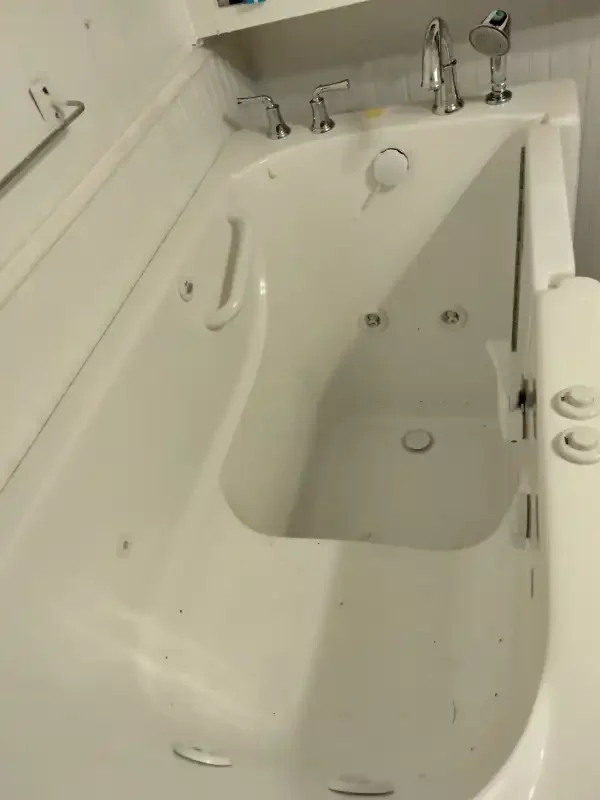
Why people ask about them
Walk-in tub calls usually come from somebody planning to stay in the house they already love. Stepping over a tall tub wall gets harder with age or after a surgery, and a tub with a door and a built-in seat lets a person keep bathing without help. That is a good reason to buy one. It is also a purchase where the showroom answers do not always match what happens when the tub gets plumbed into a real bathroom.
Norman puts these in around Pilot Point, from houses in town to places out toward Lake Ray Roberts, and the questions below are the ones he wishes every buyer asked before signing. None of them are reasons to skip a walk-in tub. They are the difference between one you look forward to using and one that sits idle because filling it is a chore.
You sit inside while it fills and drains
This surprises people more than anything else. A regular tub can be filled and then entered. A walk-in tub cannot, because the door has to be shut and sealed before water goes in. So you climb in, sit down, close the door, and then wait while it fills. At the end you wait again while it drains before the door can open, sitting in a cooling tub with wet skin.
Fill and drain speed therefore matter far more here than with any other tub. A bigger faucet and a fast drain system shorten both waits. When you compare models, ask the seller for the actual fill and drain times, and ask whether the drain speed assumes a larger drain line than most bathrooms have. The plumbing behind the wall decides how fast water really leaves.
There are workarounds that help. Some people keep a towel around their shoulders while the tub drains, and some models include a heated seat or backrest. Those details sound minor in a brochure. In practice they decide whether the tub gets used regularly or becomes a very expensive shelf.
Can your water heater keep up
Walk-in tubs are deep, and they hold a lot of water. A standard tank heater that handles showers without complaint may run out of hot water before a deep tub is full, and you will be sitting in it when that happens. Before installation, it is worth checking the size and age of your heater, and whether anything else draws hot water at the same time, such as a washing machine running in the next room.
If the heater is marginal, there are options. A larger tank, a second heater for that bathroom, or a tankless unit sized to the tub can all solve it. Sometimes the simplest step is turning the heater up a little and adding a mixing valve so the faucets stay safe. Either way, you want the answer before the tub goes in, rather than on the first evening.
A walk-in tub is also a good moment to check the heater’s general health. If it is past its useful years or already struggling, replacing it alongside the tub saves a second visit and a second disruption to the house.
The door and its seal
The door is what makes a walk-in tub useful, and it is also the part that wears. A gasket seals it when the tub is full, and that gasket has to stay clean and soft to keep water in. Ask how the door seals, whether the gasket can be replaced without replacing the door, and whether parts are easy to get. A brand that cannot supply a replacement seal is a brand to be careful with.
Inward and outward opening doors each have a case. An outward door is easier to step through but needs clear floor space in front of the tub. An inward door saves floor space but can be harder to get past for someone with limited mobility. Measure your bathroom with the door swing in mind, including where a toilet or vanity sits, before you pick a model.
Also ask about the threshold height, the step over the door frame. Lower is easier, and the difference between models can be meaningful for someone using a cane or walker. Grab bars inside and outside the tub should go into solid backing, never into bare drywall.
Jets need power, and that part is an electrician’s
Many walk-in tubs come with water jets, air jets, or both, and some include a heated seat or an inline heater. Every one of those needs electricity near a lot of water, which means a properly protected circuit installed by a licensed electrician. Plenty of bathrooms do not have a spare circuit nearby, so this belongs in the plan from the start. A tub with jets and nowhere to plug them in is just a tub.
The jets also need access for service. Most walk-in tubs have a removable panel on the front or side for the pump and motor. If the tub is going into an alcove with tile up to its face, make sure that panel can still come off. Nobody wants to break new tile to reach a pump the first time it needs attention.
Getting it in, and the old one out
A walk-in tub is tall and heavy, and it has to come through your hallway and bathroom door. Measure both before you order. Then there is the old tub to remove. A cast iron tub from an older house can weigh more than it looks, and getting it out may mean breaking it up in place. That is normal, and it is part of the job rather than an extra.
The supply valve behind the old tub is often replaced at the same time, especially in older houses where it may be decades old and stiff. Drain connections rarely line up exactly with a new tub, so the drain is adjusted to suit. In a slab house, a large shift in drain location means cutting concrete, which is why picking a model that fits the existing drain spot saves real work.
Floor strength rarely matters on a slab, but it can in an older house with a raised wood floor. A full walk-in tub with a person in it puts a lot of weight on a small footprint, so in those homes it is worth looking under the bathroom before the tub arrives.
Questions worth asking before you sign
Bring a short list to any salesperson. How long does it really take to fill and drain? How much hot water does a full tub use, and can my heater manage it? How does the door seal, and can the gasket be replaced? What electrical does it need? Will it fit through my doors and into my existing drain location? A company that answers those plainly is one worth talking to.
If the salesperson cannot answer the plumbing questions, that is fine, because that is what the plumber is for. Ask them to send the installation sheet for the model you like, and Norman will read it against your bathroom before you commit.
Our page on bathtub installation in Pilot Point covers the local side of the job, and bathtub installation explains the rest of what we install, from freestanding tubs to standard alcove replacements. Norman is happy to look at the bathroom before you buy, which is often the most useful visit in the whole project.
Speak to the owner
Before you sign for a walk-in tub, call me with the model. I will check it against your water heater and your bathroom.