
Get out first, then think about the heater
Gas companies add a smell to natural gas, the rotten-egg odor, precisely so that a leak announces itself. Propane carries a similar odorant. So when you walk into the garage and catch that smell near the water heater, even faintly, treat it as a leak until somebody proves otherwise. Do not try to track it down with your nose, and do not decide it is probably nothing because it comes and goes.
The order matters. Get everyone, pets included, out of the house. On the way, do not flip light switches on or off, do not start the car in the garage, and do not use anything that could spark, including a phone, until you are outside and away from the building. From the yard or a neighbor’s driveway, call the gas utility’s emergency line or 911. They are the ones who make the house safe. The plumbing repair comes after that.
I would rather take a call about a smell that turns out to be nothing than hear about one that got ignored. Nobody on my end will think less of you for being careful. A faint smell near a water heater is very often a small leak at a connector or a fitting, and small leaks like that are routine to find and fix. Finding it is a job for gauges and test solution.
Where leaks hide around a water heater
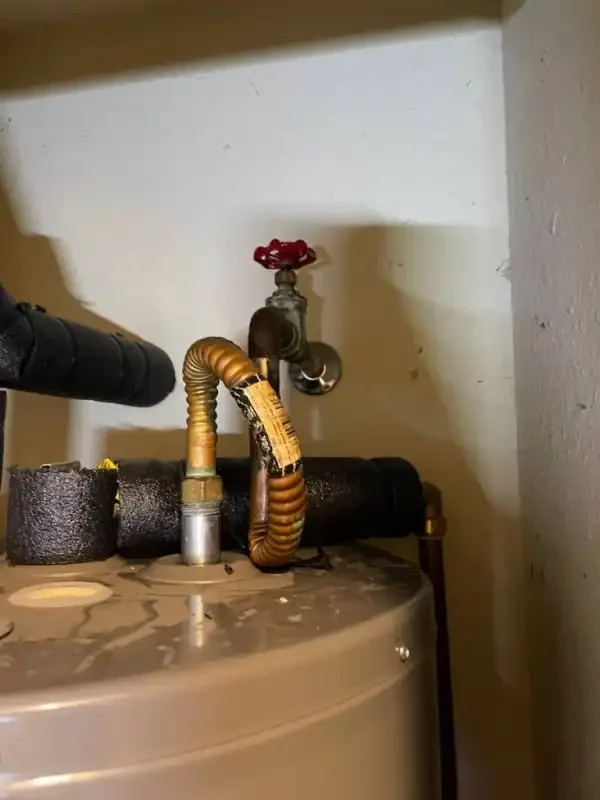
A gas water heater has a short run of connections, and each one is a place a leak can start. There is the shutoff valve on the supply line, a flexible connector from that valve to the heater, a sediment trap at the bottom of the drop, and the threaded connection into the gas control on the tank itself.
Older connectors are the usual trouble. Some uncoated brass connectors from decades back are no longer considered safe to keep in service, and any connector that has been kinked, stretched or rubbed against the tank can crack at the bend. Fittings corrode too, especially in a damp garage or where a water leak from the heater has been dripping onto the gas line for a while. Each of those can produce a leak small enough to smell and too small to hear.
The heater’s own control valve can leak too, at the inlet or where the pilot tube joins it, and that one is not a fitting you tighten and walk away from. If the leak is inside the control itself, the control gets replaced, and on an older tank that starts the repair-or-replace conversation.
A heater that was moved or replaced at some point is worth a closer look as well. Every time a connector is taken off and reused, or a fitting is loosened and retightened, there is a chance the seal does not seat the same way twice. The newer the work, the more likely it was done right, but newer is not a guarantee, and I check the connections on a replaced heater the same way I check an old one.
How a leak actually gets found
Once the utility has been out and the house is safe to enter, finding the leak starts with the whole system before the one spot that smells. A gauge goes on the gas piping and the system is brought to a test pressure with the appliances shut off. If the needle holds, the piping is tight. If it falls, there is a leak somewhere on that system, and the next step is narrowing down where.
That narrowing is done with leak test solution brushed or sprayed on every joint, fitting and connector in question. A leak shows as bubbles, sometimes a slow foam and sometimes a steady froth. An electronic detector helps around tight spots and behind the heater where you cannot see the joint well. Between the gauge and the solution, the leak is pinned to one fitting or one length of connector, and that is what gets repaired.
You may have read about doing the soap test yourself. Please do not treat that as a repair plan. Testing and tightening a gas fitting without the right gauge, the right sealant for that joint and a pressure test afterward is how a small leak becomes a bigger one. If you smell gas, your part is getting out and making the call. Mine is the rest.
What the repair looks like
Most leaks at a water heater come down to one of three repairs. A failed or outdated connector gets replaced with a new one of the right length and rating, run without kinks and without touching the tank jacket. A leaking threaded fitting gets taken apart, cleaned, resealed with the right compound and reassembled. A shutoff valve that weeps at the stem or will not close fully gets replaced outright, since a gas valve you cannot trust is not worth keeping.
While the line is open, the sediment trap gets checked. That short capped pipe at the bottom of the drop catches scale and debris before it reaches the gas control, and some installs never had one. If it is missing, this is the time to add it. The same goes for a connector that runs through a wall or floor where the code wants solid pipe instead. Fixing the leak and leaving the reason for it in place would just be booking a return visit.
Tested before the gas goes back on
No gas repair is finished until the system has been pressure tested again. The same gauge goes back on, the piping is held at test pressure, and the needle has to stay put. A needle that creeps is a fail. If it moves, the joints get checked again until it holds. Where the city asks for a permit on gas work, the permit gets pulled.
Once it passes, the gas comes back on and every appliance on that line gets relit and checked, starting with the water heater. That means the pilot or igniter, then a clean blue flame at the main burner, then a look at the draft at the vent. The furnace and range get the same attention, since shutting off the gas affected them too. Then each new joint gets one more pass with test solution while the system is under normal pressure.
Propane, clay and the lines past the garage
Not every place around Aubrey is on a gas main. Acreage with a shop or a barn may run on a propane tank, and the same rules apply to a propane smell: get out, then call your propane supplier or 911 from outside. Propane is heavier than air and settles low, so a smell near the floor of a garage or a crawl space matters even more. The repair and testing work the same way once the system is safe.
Lines beyond the heater can leak too. A buried gas line out to a shop or a grill can be hit by a post-hole digger or a trenching job, and the clay here expands when wet and pulls back when dry, which works at pipe and fittings near the slab over a season. A leak there can show up as a smell in the yard, dead grass along a line, or a gas bill that seems off. Those get the same gauge, the same search and the same test.
Who to call, and in what order
Smell gas: leave, then call the utility or 911 from outside. House declared safe, or the gas shut off at the meter: call a licensed plumber for the repair. How gas repairs run in town is laid out on the gas line repair page for Aubrey, and the broader picture sits under gas line repair.
One more thing worth doing once everything is fixed: learn where your gas meter or propane tank sits. You should never need to work a valve there yourself during a leak, since the utility or the fire department handles that, but knowing where it is saves them a search when they arrive.
When you call (940) 231-5706, I answer, and I am the one who comes out, finds the leak and signs off on the test. If you are not sure whether what you smelled was gas, treat it as gas and get outside before you dial.
Ask the plumber
Get everyone outside first, then call me and I will find where it is coming from.