

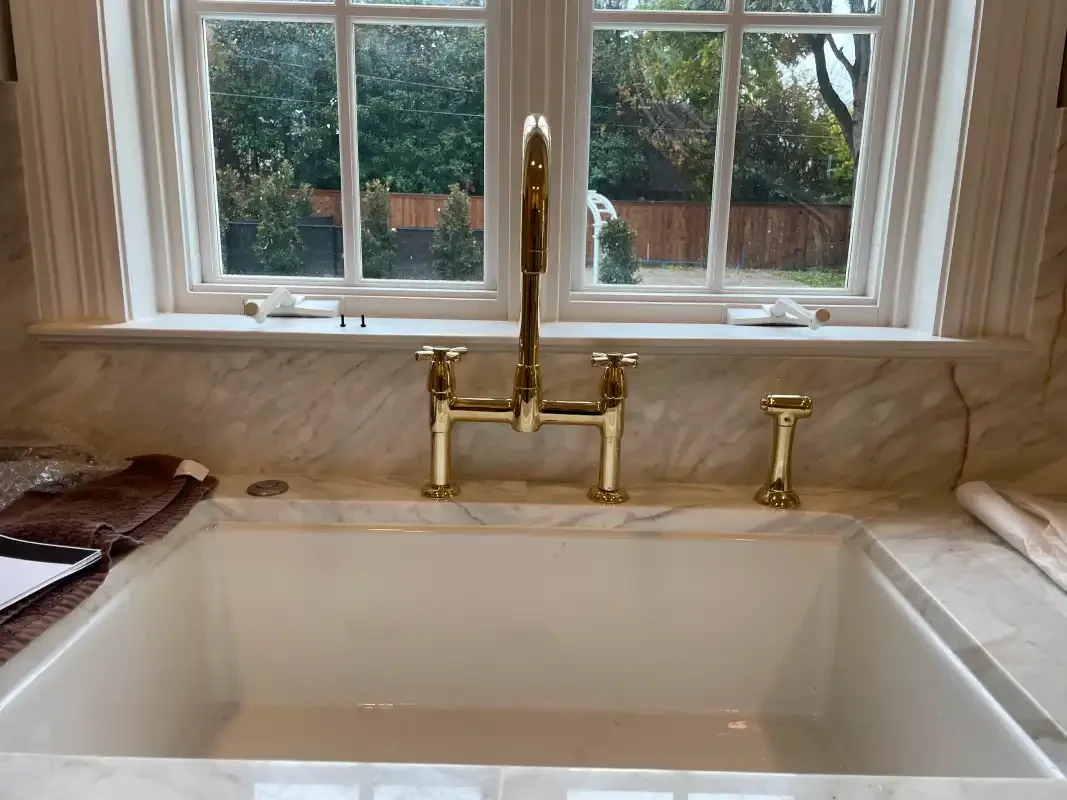
Faucet Installation in Aubrey.
Picking the faucet is the fun part. Getting it on the sink so it never drips under the cabinet is the part Norman handles, in kitchens, bathrooms, laundry rooms and the utility sink out in the garage, with new shutoffs and supply lines going in alongside it.
Start with the holes in the sink
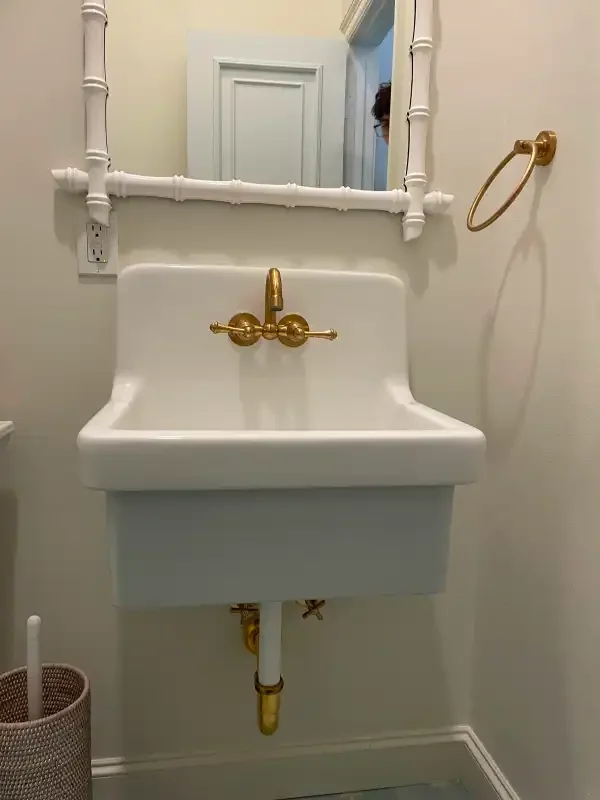
Every sink or counter is drilled for one kind of faucet, and the faucet has to suit the drilling rather than the other way around. A single-hole faucet has one body with a single lever. A centerset sits over three holes close together, spout and handles on one base. A widespread spreads the spout and two handles across three holes set further apart. A wall-mount skips the deck entirely and comes out of the wall above the bowl.
So count what is there with a flashlight under the sink before you shop. Measure the distance between the outer holes too, since that is what separates a centerset from a widespread. Buying the faucet first and hoping is how people end up with a spare hole they did not want, or one too few. A spare hole can take a deck plate, a soap pump or a filter tap. A faucet that needs more holes than the sink has means drilling, and in stone that is work for the counter fabricator rather than the plumber. When a kitchen is being redone and the counter is new, the drilling is easiest to settle with the fabricator before the stone is cut. If you already own the faucet, keep the box, because the spec sheet inside answers most of these questions by itself.
Wall-mount faucets and the garage sink
A wall-mount faucet has to be planned while the wall is still open, because its valve and supply lines sit inside the wall itself.
The height above the bowl and the spacing between hot and cold get set during rough-in, and then the drywall or tile closes around them. Changing your mind about the faucet after that means opening the wall again. Bring the exact model to that conversation, because two wall-mount faucets that look alike can call for different depths in the wall.
Utility and laundry sinks in garages, shops and laundry rooms are the other common setup. Exposed lines make the next repair easy because everything is in sight. If the garage sink is new, the drain matters as much as the faucet, and a shop with no drain at all needs one run before a sink makes sense, which is the work on the sewer line installation page. In a shop or barn out on acreage, think about winter as well: a supply run along an outside wall of an unheated building is exactly what splits in a hard freeze. A hose-thread faucet that feeds a hose wants a vacuum breaker, for the reason covered on the backflow testing page.
What goes in along with the faucet
New shutoffs under the sink
The small valves under a sink seize after years of hard water, and a seized one only shows itself the day you need it. Since the water is already off for the swap, they get replaced instead of trusted for another decade.
Fresh supply lines
New braided lines of the right length go on with the faucet. An old line that has sat kinked behind a cabinet for years is not worth saving.
Sealed where it meets the deck
The base gets the gasket or sealant its maker calls for, so water left standing on the counter cannot creep under the faucet and into the cabinet.
The drain lined up
A bathroom faucet often brings its own drain and tailpiece. The trap is set to meet it squarely instead of bent over to reach, since a joint under strain becomes a slow leak.
Room for the pull-down hose
A pull-down kitchen faucet hangs a weight on its hose, and that weight needs a clear path past the trap, the disposal and whatever is stored down there. Set it in the wrong spot and the spray head never settles back in place.
Flushed and checked dry
Lines are flushed before the aerator goes on, so grit knocked loose during the swap does not end up in the new cartridge. Then every joint under the sink gets checked by hand and flashlight with the water running.
Hard water and the part inside the handle
The finish is what you pick a faucet for. The cartridge inside it is what decides whether you still like it in a few years.
Hard water runs across most of this part of North Texas, and its minerals settle on every moving surface inside a faucet. A cheap cartridge starts to stiffen, drip or mix the temperature badly long before the finish shows any wear. A better one, usually a ceramic disc from a maker that still sells parts, keeps turning smoothly and can be replaced by itself years later without buying a whole new faucet. When you are torn between two models, ask which one you could still get a cartridge for.
The aerator at the tip catches scale as well, and when the flow from a newer faucet drops off, unscrewing it and clearing it is often the whole fix. If the hot side runs lukewarm at every tap in the house, though, the faucet is not the problem, and the water heater repair page is the better place to start. A faucet that simply drips may only need faucet repair. Norman works the older houses and the new subdivisions around Aubrey alike, and you can supply the faucet yourself or have him bring one. Call (940) 231-5706, describe the sink on the contact page, or look through finished work in the gallery. More on the service is on the faucet installation page.
Other work A+ does in Aubrey
Water Heater Repair: pilots, elements, valves, leaks.
Gas Line Repair: leaks found, fixed, pressure tested.
Sewer Line Installation: new drains for shops, additions.
Backflow Testing: the yearly sprinkler test.
Everything else in town is on the Aubrey page, and the faucet installation page has the full write up on this job wherever you are.
What people ask before buying a faucet
Can I buy the faucet myself and have you put it in?
Yes, and plenty of people do. Keep the box and the instructions, and check the hole count against your sink before you buy. If you do not want to shop for one, Norman can supply a faucet that suits the sink and the water here.
Will a new faucet fit my old sink?
If it matches the drilling, yes. Count the holes and measure between the outer two, then compare that with the faucet’s spec sheet. A spare hole can be covered or put to use. Too few holes means drilling, which in stone belongs to a fabricator rather than a plumber.
Do you replace the shutoff valves under the sink too?
Yes, as a rule. Those little valves are usually as old as the house and stiff with scale, and the water is already off for the faucet. Swapping them now beats discovering one will not close on the night a supply line lets go.
Why is the pressure low at my new faucet?
Most often a little debris from the old supply lines has lodged in the aerator or the cartridge screen. Clearing it usually brings the flow back. If the pressure is low at every fixture rather than just one, the cause is upstream, and that is a different conversation worth having.
Can you add a wall-mount faucet to a finished wall?
Yes, but the wall has to be opened to set the valve and supply lines at the right height and depth, then patched or retiled afterward. It is far simpler during a remodel, while the studs are bare, so mention it early if a wall-mount is on your list.
Do you install faucets in rentals and commercial kitchens?
Yes. Rental owners often want a sturdy faucet with parts that will still be sold for years to come, which beats replacing the whole thing between tenants. A restaurant prep sink and a bathroom vanity in a house are both handled by the same licensed plumber.
Worth keeping the number
The owner Norman is genuine and very timely. We had express service, outstanding results, with zero issues. I highly suggest you keep A+ Plumbing’s number in your phone.
Speak to the owner
A faucet is a small job done right once, with new shutoffs under it so the next one is just as easy.