
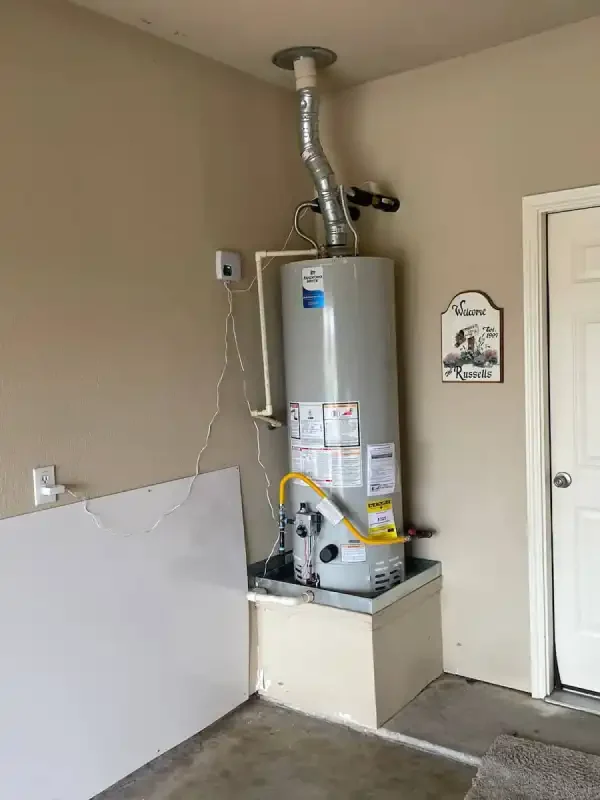
Cold water at the sink, and a dark window on the heater
A gas water heater that stops making hot water usually gives one clue right away. Most tanks have a small sight window near the bottom, behind the burner cover, and when everything is working you can see a little blue flame through it. When the pilot is out, that window is dark. People call the shop after relighting it two or three times, watching it burn for a minute, then finding it out again by morning. That pattern is useful information, and it points at a short list of causes.
This post is about fixing the heater you already own. Most no-hot-water calls on gas units end in a repair, and a fair number end with the owner fixing it themselves once they know what to look at. A few end with the tank, and I will say plainly when that is where it is heading.
What you can safely check first
Start with the gas itself. If the range or the furnace runs on the same supply and they are working, gas is reaching the house. Then look at the small valve on the line feeding the heater, usually a lever on the pipe just above or beside it. The handle should run in line with the pipe. If somebody bumped it during a garage cleanout, it may sit partly closed, and a starved pilot is a weak one.
Next, read the label on the front of the tank. Every gas heater carries its own lighting instructions, and they differ between brands and between older standing-pilot models and newer ones with a push-button igniter. Follow that label and nothing else. If you smell gas at any point, stop, leave the house, and call the gas utility or 911 from outside. A faint smell is never something to light a match over.
On newer sealed-burner heaters there is often a flame arrestor screen near the bottom where the burner draws its air. In a garage that screen collects lint and dust, and once it chokes, the burner cannot get enough air and the heater shuts itself down to be safe. Some models also lock out after several failed attempts to light. The label tells you whether yours does and how to clear it, and if it does not say, leave it alone.
The part that usually gives out
When the pilot lights fine and goes out the moment you let go of the knob, the usual suspect is the thermocouple on an older heater or the flame sensor on a newer one. Either way it is a small part sitting in the pilot flame whose whole job is to tell the gas valve that a flame is present. When it wears out or gets coated, the valve never gets that signal, and it shuts the gas off as designed.
That is a safety device doing its job, and replacing it is a gas-side repair. The new part has to be the right one for that control, seated in the flame at the right depth, and the connection at the valve has to be tight without being cranked. After it goes in, the fittings that were disturbed get leak checked before I leave. It is a modest repair on most heaters, and it puts a lot of tanks back in service.
Sometimes the pilot is fine and the main burner is not. You hear a click, maybe see a short flame, then nothing. That can be a dirty burner, a pilot flame that has gone weak and yellow from a clogged orifice, or a gas control valve that has failed. The control valve is the most expensive of those parts, and it is worth an honest look at the age of the tank before ordering one.
Why a garage heater acts up more than a closet one
A lot of gas water heaters sit in the garage on a raised platform, and that placement has its own habits. Wind comes under the overhead door and can blow a weak pilot out. A car parked close kicks up dust that ends up in the burner. In older houses the vent connector can rust where it meets the flue, and a heater that cannot vent properly will not keep a steady flame.
Venting deserves its own sentence, because it is the one part of this I never want an owner to guess at. A heater that is spilling exhaust back into the garage instead of sending it up the flue is a carbon monoxide problem before it is a hot water problem. Scorching around the top of the tank or a sooty draft hood are the signs. If you see either, turn the heater off at its control and call.
Hard water and the tank you cannot see inside
Most of this area runs hard water, and on a gas tank the scale settles in a layer on the bottom, right over the burner. That layer insulates the water from the flame, so the burner runs longer to heat the same tank, the bottom of the tank runs hotter, and you start to hear popping and rumbling as water trapped under the scale boils through it. None of that puts the pilot out directly, but it ages the whole heater faster.
Flushing the tank helps when it is done regularly and the sediment is still loose. On a heater that has gone a long time without a flush, the drain valve can clog the moment you open it, or refuse to close properly afterward. On a newer house, flushing now is worth doing. On an old tank that has never had one, it can start the very leak you were hoping to avoid, so that one is a call to make with a plumber standing there.
Repair or the end of the tank
The question I get asked most on these calls is whether the heater is worth fixing. A thermocouple, a flame sensor, a cleaned burner or an arrestor screen are all repairs that make sense on almost any heater that is otherwise sound. A gas control valve on an older tank is closer. And a tank that is leaking from the body itself, with water weeping out of the steel or rust at the bottom seam, is finished. No part fixes a tank that has rusted through.
Water at the base is not always the tank, which is why it gets looked at before anything is decided. A dripping relief valve, a loose fitting on top or condensation on a cold morning can all leave a puddle, and those are fixable. The difference is usually obvious once the cover is off and the top of the heater is dry or wet. If it does turn out to be the tank, you will hear that straight, along with why.
Newer houses are not immune. Plenty of the heaters in the new subdivisions around Aubrey came in with the house, and builder-grade units can start giving pilot and burner trouble sooner than owners expect, especially with hard water working on them. A young heater with a failed sensor is almost always a repair, and I would rather fix it than sell you a tank you do not need.
When to call instead of relighting again
If you have relit the pilot by the label and it goes out again, stop relighting it. Every attempt is another round of gas at a burner that is already telling you something is off. Note what it did: whether the pilot would not light at all, lit and died when you let go, or ran fine and then went out later. That one detail saves time on the visit, because it narrows the list before the cover even comes off.
The details on how this work runs in town are on the water heater repair page for Aubrey, and the full range of what gets fixed is under water heater repair. Aubrey is the next town up US 377 from the shop in Krugerville. Call (940) 231-5706 and you talk to me, the plumber who will be looking at the heater.
Start with a phone call
Tell me what the heater did before it quit and I can usually tell you which part gave up.