
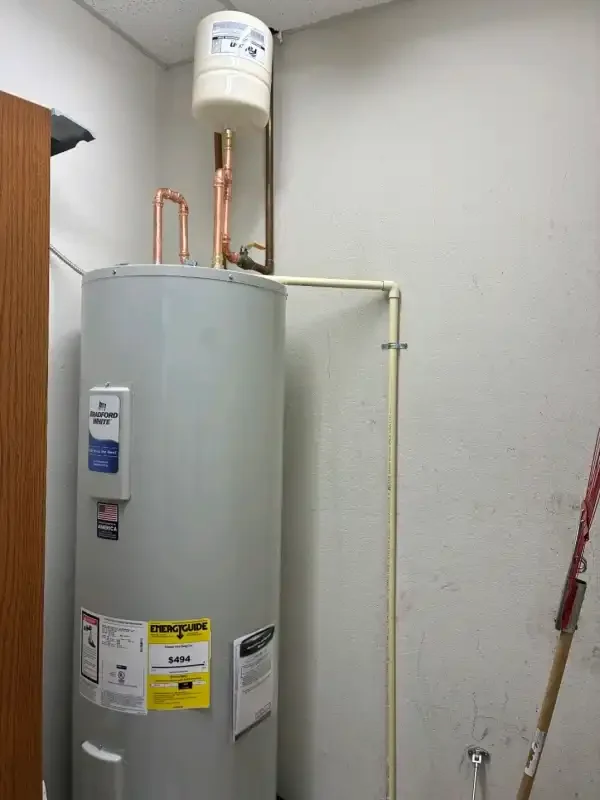
Signs the old tank is near the end
Most water heaters give some warning before they quit. The first sign is often rusty water in the first few seconds of a hot tap, which usually means the inside of the tank is rusting through. Another is a rumble or a pop when the burner or the elements come on, which is sediment cooking on the bottom. The one that matters most is water at the base. A tank that weeps around the bottom seam is not going to seal itself, and it will not wait for a convenient weekend either.
Hard water speeds all of this up, because the minerals settle into a layer that the heat has to fight through. When I get a call about a noisy tank, I ask how old it is and whether anyone has ever drained it. If the answer is fifteen years and never, the conversation is usually about replacement rather than repair. A tank with a leaking body cannot be fixed. A failed valve or element sometimes can, and I will say so when that is the case.
Measure the closet before you shop
In a lot of older Denton houses the water heater lives in a closet that was built around the tank it came with. Some are narrow interior closets off a hallway or a utility room. Others are small closets built into an outside brick wall, with a door that opens to the yard. Either way, the closet was sized for a tank from decades ago, and new tanks are often a little wider for the same capacity because the insulation is thicker.
So the first thing I measure is the door opening, then the inside width and depth, then the height up to anything overhead. A tank that fits the closet but not the door is a bad afternoon for everybody. If the numbers are tight, there are taller, slimmer models, and sometimes the right answer is a slightly smaller tank that actually fits rather than a bigger one that has to be forced. Getting this right on the phone, before anything is ordered, saves a second trip.
If the closet opens to the outside, I also look at the door and its frame. A rusted threshold or a door that will not latch lets weather in on the new tank, and that is easier to sort out while the closet is empty.
Gas flue or electric wiring
A gas heater in a closet has a flue running up through the ceiling, and the new tank has to line up with it. If the new unit sits taller or the flue outlet lands in a different spot, the vent pipe gets adjusted so it rises the whole way with tight joints. A gas heater also needs air to burn, which is why a closet door with louvers or a vent is not decoration. I check both before the old tank comes out.
Electric tanks skip the flue but bring their own questions. The circuit and the wire feeding the old heater have to match what the new one draws, and the connection at the top of the tank has to be in good shape, with nothing scorched or loose. If the house has gas at the closet and you are thinking about switching fuel, that is a bigger job than a swap. Most people stay with what the house already has, and that is usually the sensible call.
What comes with a new install
Replacing a tank is the right time to bring the install up to how it should be done now. An expansion tank goes on the cold line above the heater in a lot of houses, because heated water expands and has to go somewhere when the system is closed off. It takes pressure off the tank, the valves and every fixture in the house.
Where a leak could reach finished floors, the tank sits in a drain pan. The relief valve on the side gets a line that runs to a safe spot, so if it ever opens it does not spray the closet. On gas heaters there is a shutoff at the tank and a sediment trap ahead of the controls. None of these are upsells. They are the parts that turn a tank in a closet into an install you can stop thinking about.
If your current heater has none of this, that does not mean it was installed wrong for its day. Expectations have moved, and a replacement is the easiest moment to catch up, since the closet is already empty and the water is already off.
Size it for how the house uses hot water
The easy move is to put back the same size tank that came out. Sometimes that is right. Households change, though. A couple who bought the house twenty years ago may now have three teenagers, or the reverse. A tank that ran out in the middle of the second shower every morning was never the right size, and replacing it with the same one just buys another decade of cold showers.
So I ask how many people live there, how many bathrooms get used in the morning, and whether there is a big soaking tub. That tells me more than the number printed on the old label. If the closet will not take a bigger tank, we talk about a faster recovery model or other options. Tankless comes up too, and I will give you the honest version of that pitch, including when it does not suit an older house.
Sediment matters for sizing as well. A tank packed with it holds less hot water than its label says, which is part of why an old heater seems to shrink over the years. Flushing a new tank once a year keeps more of that capacity, and I will show you where the drain valve is before I leave so it actually gets done.
Clear the way before I arrive
Water heater closets collect things. Paint cans, a mop bucket, holiday boxes, the vacuum. Before I get there, it helps a lot to empty the closet and clear a path from the closet to the nearest door, because a full tank weighs a great deal and the old one has to come out the same way the new one goes in. If the closet opens onto the yard, move anything stacked against that wall outside.
It also helps to know where the main water shutoff is and whether it turns. I will shut the cold supply to the tank, drain it and disconnect it, but a seized main means we are working around a valve that might not hold. If you are unsure, check it before the day. If it will not budge, tell me on the phone and I will plan for it.
Pets and small kids are worth a thought too. The front door may stand open while tanks go in and out, and a draining heater sends hot water through a hose across the floor. Keeping the dog in another room for an hour makes the day easier on everybody, the dog included.
Hauling the old one away
When the new tank is in, I fill it, bleed the air out of the hot lines, check every joint while it heats, and light the burner or turn on the breaker only after the tank is full. An empty electric tank with power on burns out an element in seconds. Then the old tank goes on the truck. You do not have to figure out what to do with a dead water heater on the curb.
There is more on how this work goes in town on the water heater replacement page for Denton, and the general picture of what I install is under water heater replacement. Denton is part of my home county, and A+ works out of Krugerville. Call (940) 231-5706 and the licensed master plumber answers, with no dispatcher in between. Tell me the size on the label and send a photo of the closet if you can, and I can usually tell you on the call what the swap involves.
Get Norman on it
Send me a picture of the closet and the label on the old tank, and I will tell you what the new one needs.