
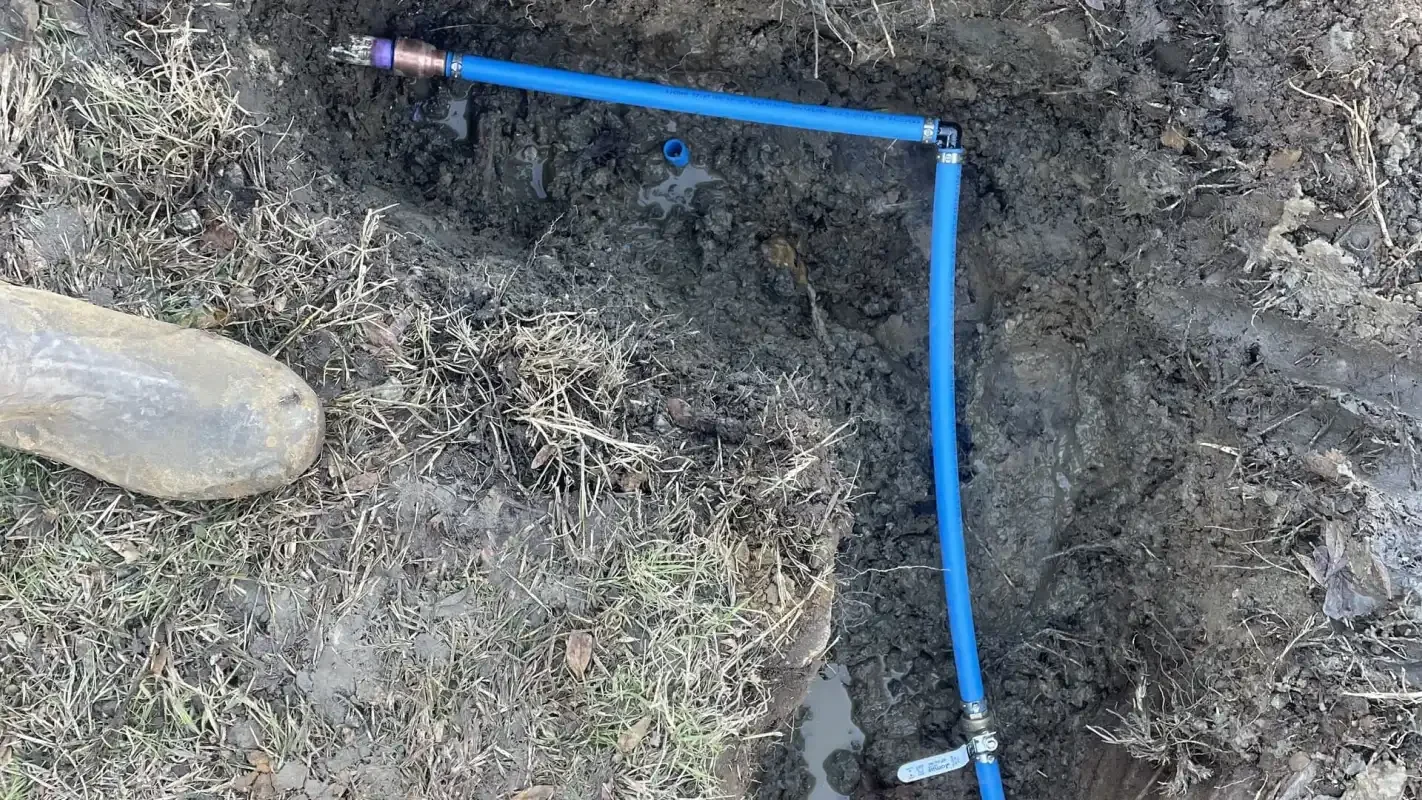
The patch of grass that stays green
It usually starts in August. The rest of the yard has gone brown and crunchy, and one strip between the street and the house is still green, or soft underfoot, or growing faster than everything around it. Sometimes there is standing water after a dry week. People assume a sprinkler head, and sometimes it is one. When the sprinklers are off and the spot stays wet anyway, the water service line is the next thing to suspect.
That line is the pipe that carries water from the meter, or from the well, into the house. It runs underground the whole way, so nobody sees it until it leaks. A small leak on it can run for a long time, and the only signs are that wet patch and a water bill or a well pump that seems busier than it should be. Left alone, it rarely gets smaller.
Where your water line actually runs
In town, the meter tends to sit near the street and the line to the house is fairly short and direct. Around Pilot Point, though, a lot of properties are on acreage, and the meter or the well can be a long way from the front door. On those places the service line often does more than feed the house. It may branch off to a barn, a shop, a yard hydrant for livestock water, or a second building, and every branch is another run that can fail.
Knowing the route matters before anything else, because the wet spot is not always above the leak. Water follows the trench backfill and the slope of the ground, so it can surface well downhill of the actual break. On a property with branches, the leak might be on a line nobody remembered was there. Part of the first visit is working out where the pipes go, and that alone can save a lot of digging.
Checking it yourself with the meter
If you are on city water, there is a quick check you can do before calling anyone. Turn off every faucet, appliance and irrigation zone in the house and yard. Then go look at the meter. Most have a small leak indicator dial, often a triangle or a star, that spins with even a tiny flow. If it is turning while nothing is running, water is going somewhere it should not.
Write down the meter reading at night and again first thing in the morning, with nobody using water overnight. If the number moved, the leak is real even if the dial is hard to read. That simple test is also useful after a repair, to confirm the leak is gone rather than just quieter.
On a well, the clue is the pump. If it kicks on when nobody has used water, or the pressure tank cycles more often than it used to, something downstream is drawing water. A drop in pressure at the taps points the same way, especially if it came on gradually. None of these tells you exactly where the leak is, but together they tell you whether it is worth a proper look.
Finding it without digging the whole yard
Locating comes before digging. Listening equipment picks up the sound of water escaping a pressurized line, and on plastic pipe that sound is faint, so it takes patience and a still day. Shutting valves on individual branches narrows it down on a property with several runs. The aim is to open one small hole in the right place instead of a trench across the lawn hunting for it.
Sometimes the cause is obvious once the spot is opened: a fitting that pulled apart because the clay shifted, a crack where a root wrapped the pipe, or an old joint that finally gave up. Sometimes the pipe itself is the problem along its whole length. Which of those it is decides the next step, and nobody should be guessing at it before the dirt is moved.
The locate also settles who handles what. The pipe on your side of the meter is usually yours, and a leak on the street side of it belongs to whoever supplies the water. If the noise points back toward the meter box, you will be told so, and you can call them instead of hiring a plumber for work that is not yours to fix.
Patch one section or replace the run
A single failure on a line that is otherwise sound gets a repair. A section is cut out, new pipe goes in with proper fittings, the line is pressure checked, and the hole is closed. That is a modest job, and on a decent line it can be the right answer for many years. Replacing a whole run because one coupling let go is not something we recommend without a reason.
The reason is usually the pipe material or a pattern of failures. If this is the third leak on the same line, or the pipe is a type known to fail over and over, another patch only sets the date of the next one. In that case the honest advice is a new line from the meter or well to the house, and you will be told why in plain terms before anything is agreed.
Old pipe, new pipe
Around the old downtown square, the houses went up generations before the new streets on the edges of town, and their service lines show it. Galvanized steel rusts from the inside until the flow chokes down and the threads weep. Gray polybutylene, common in houses from the late seventies and eighties, tends to fail at the fittings. Newer construction mostly uses PEX, which handles the shifting clay and the cold far better.
Galvanized, gray poly and copper do not get along at the joints, either. A repair that ties new pipe into old has to use the right transition fittings, or the joint becomes the next leak. That is one of the details that separates a repair that lasts from one that buys a season.
When a line is replaced, it usually goes in as PEX or another approved modern pipe, buried at a proper depth so a February freeze does not reach it. Where the new line has to cross under a driveway or a sidewalk, it can usually be bored underneath instead of breaking the concrete out. That keeps the job contained and leaves the slab you drive on in one piece.
What happens to the yard
Nobody wants a mud trench left behind. Where the sod has to come up, it is cut in strips and rolled to the side, then laid back once the trench is filled and settled. It is slower than tearing it up with a machine, and it is the difference between a yard that looks normal again soon and one that needs replanting. Leftover dirt and old pipe leave with the truck.
Before the trench is closed, the new section stays under pressure long enough to prove it holds, and the meter is checked again with everything off. If the barn line or a yard hydrant shared that trench, it gets checked too. Then the dirt goes back in layers, packed as it goes, so the trench does not sink after the first good rain.
For more on how this works around town, read our page on the water service line in Pilot Point, or the general overview of water service line work. If the meter dial is spinning right now, call and Norman will tell you how soon he can get out to look at it.
Start with a phone call
Call with where the wet spot is and what the meter is doing. That is enough to start.