
When patching stops making sense
Repiping usually starts with a leak that is not the first one. A pinhole in a wall last spring, another under the kitchen sink in the summer, and now a wet spot in the hall closet. Each one got fixed, and each fix was fine. The problem is the rest of the pipe, which is the same age and the same material as the pieces that already failed.
At that point the question changes. It stops being where the next leak is and becomes how many more you want to wait for. Replacing the supply pipe in the whole house sounds like a huge project, and on a slab house people picture jackhammers in the living room. On most of the houses I repipe, nobody touches the floor at all.
A repipe replaces the supply side only, the pipes that carry pressure to the faucets, the water heater and the outside spigots. Drains are a separate system, and if they are also old, that is a different conversation that starts with a camera.
The pipe that keeps failing
In older houses the usual culprit is galvanized steel. It rusts from the inside, the same way an old drain scales, until the opening is a fraction of what it was. The signs are low pressure that gets worse over the years, rusty or brown water after the taps sit, and pinhole leaks at the threads. You cannot clean the inside of galvanized pipe back to new. Once it is choked, it gets replaced.
The other one is gray polybutylene, a plastic supply pipe used in a lot of houses from the late seventies and eighties. It tends to fail at the fittings without much warning, and insurers often ask about it when a policy is written or renewed. If you have gray plastic coming out of the wall at the water heater or under a sink, it is worth a look. There is a separate page for polybutylene replacement.
Why the floor stays closed
Almost every house in Denton sits on a slab, so the original supply lines often run under the concrete. When one of those leaks, you are into leak location and either breaking the floor or tunneling to reach it. Repairing the old lines in place means doing that again every time another spot gives out. Repiping lets us leave them where they are, cap them off, and stop relying on them. Old lines left capped under the slab do no harm once nothing feeds them.
Newer houses built in the last fifteen years or so mostly use a manifold, a central point where each fixture gets its own line. Those are a different story and rarely need a full repipe. The houses I repipe are mostly older ones, where pipe ran from fixture to fixture through the slab and the walls, and where decades of hard water and corrosion have done their work.
Running the new pipe overhead
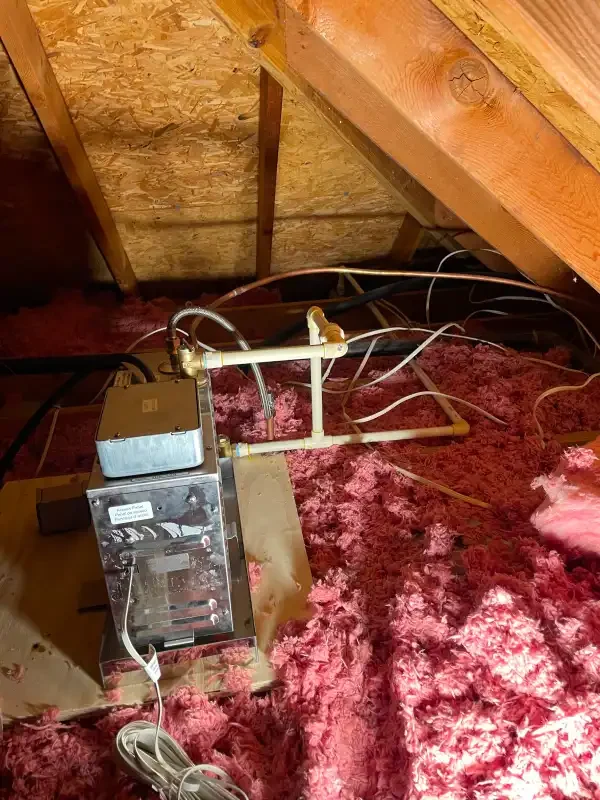
The new supply runs through the attic. From the main shutoff, a new line climbs up into the attic and runs across it, and from there branches drop down inside the walls to each fixture: the kitchen sink, each bathroom group, the laundry, the water heater, the hose bibbs. Coming down from above means the pipe reaches every fixture without going anywhere near the floor.
The new pipe is often PEX, a flexible plastic supply line, with copper where it comes out of the wall at a fixture or a hose bibb. Flexible pipe can be fished down a wall cavity in one piece, which means fewer joints hidden in the wall and fewer places for a future leak. Every branch gets a shutoff at the fixture end, so a single faucet can be worked on later without turning off the whole house.
The main shutoff often gets replaced during the same job. It is the valve everyone reaches for in a hurry, and a repipe is the obvious time to make sure it closes in one turn.
Attic pipe and a February freeze
The attic route has one weakness, and anyone who has been through a hard freeze here knows it. Attics are not heated, and North Texas gets cold enough often enough to split pipe that sits exposed up there. February is when my phone rings the most, and a lot of those calls are attic lines and garage lines that froze overnight.
So a repipe through the attic is done with the cold in mind. Pipe stays down low, tucked against the ceiling drywall and buried under the insulation, where heat from the rooms below reaches it. It stays away from the eaves and the gable vents, where the cold air comes in. Any run that has to cross an open or drafty spot gets wrapped. Done that way, the attic stops being the weak spot in the house.
How big the wall openings get
Dropping pipe down a wall still means openings, and I keep them small. Usually that is a hand-sized cut near the top of a wall and another where the pipe meets the fixture, often inside a cabinet or behind a toilet where it will not show. Sometimes the cleanest spot is from outside the house.
Drywall patches are part of the conversation from the first visit. Who closes the openings, how they get finished, and whether the painter comes after are all settled before any wall gets cut. Nobody should be left at the end with a row of holes and a shrug. If a cabinet back or a closet wall is the least visible way in, that is the way I go.
Doing it all at once or in stages
I plan a whole-house repipe so the family has water in the evenings wherever the job allows. That suits a lot of owners, because it gets done, the old pipe goes out of service, and the leaks stop. It does not have to happen all at once, though. A house can be repiped a section at a time, starting with whichever part is failing first.
Doing it in stages works best when the attic trunk line goes in first, sized for the whole house, with capped branches waiting for each area. Then a bathroom group gets connected this spring, the kitchen and laundry later, and so on. Each stage ties into the same new main instead of a patchwork. It spreads the disruption out, and it means the first stage does not have to be redone when the second one comes along.
Starting the conversation
The first visit is a walk through the house: under the sinks, at the water heater, up in the attic if there is room to move. That shows what the pipe is, where it fails, and which route the new lines can take. From there you get a plan for the whole house and a plan for doing it in pieces, so you can pick the one that suits the house and the budget.
The way repipes run here, from the attic route to the patching, is on the Denton pipe replacement page, and the general approach is under pipe replacement. Call (940) 231-5706 with the age of the house and how many leaks you have had, and we can set up a time to look.

Start with a phone call
If your pipe has leaked twice, call me before it leaks a third time and we will look at the whole house.