
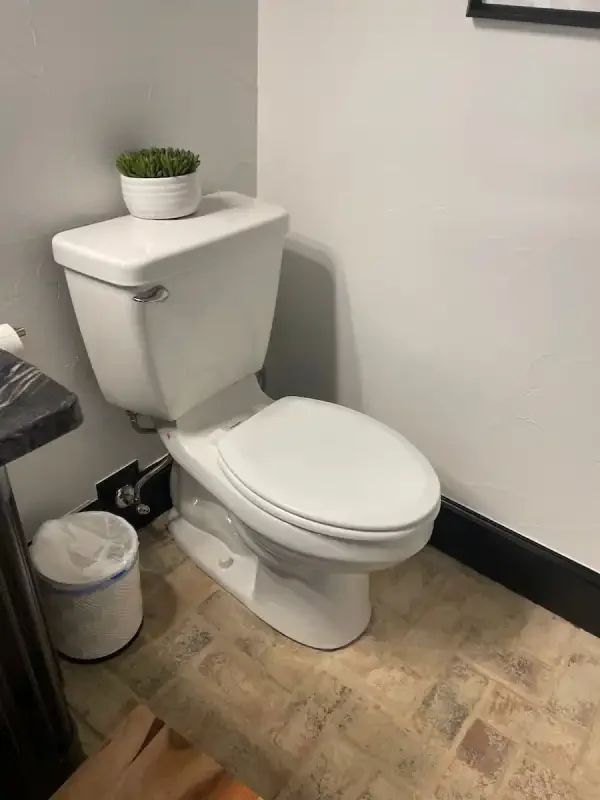
One measurement decides the toilet
People pick a toilet the way they pick a faucet, by how it looks in the store. Then it comes home, the old one comes out, and the new one does not fit the drain. The number that decides which toilets will work is the rough-in, the distance from the finished wall behind the toilet to the center of the drain in the floor. It is printed on every toilet box, and it has to match your bathroom.
Get it wrong one way and the tank hits the wall before the bowl lines up with the drain. Get it wrong the other way and the toilet sits out from the wall with a gap that looks odd and wastes floor space in a small room. Both are avoidable with a tape measure and two minutes.
Rough-in is the one number worth settling before anything else. Color, bowl shape and the style of the flush handle can all be chosen once you know which toilets fit the space.
How to take the measurement
With the old toilet still in place, look at the two bolts holding the base to the floor, usually under small plastic caps. Measure from the wall behind the toilet to the center of one of those bolts. Take it from the wall surface above the baseboard, since the baseboard’s thickness throws the number off. If the base has four bolts, use the back pair.
Most houses measure close to 12 inches. If yours comes out around 10 or 14, that is a less common rough-in, and the choice of toilets gets narrower, though models are made for both. Write the number down, take a photo of the old toilet from the side, and send both to me before you buy anything. I can tell you on the phone whether the one you like will fit.
Older bathrooms and odd numbers
The odd measurements show up most in older houses, and in bathrooms where someone has already moved things around. Sometimes the wall behind the toilet has been furred out or retiled over the old surface, which shortens the rough-in by the thickness of the new layer. A toilet that fit fine before that work may not fit after it.
If the drain is in the wrong spot for the toilet you want, there are two routes. One is to buy a toilet made for your rough-in. The other is to move the drain, and on a slab house that means cutting concrete. For a straight toilet swap, moving the drain is almost never worth it. During a full remodel, with the floor already open, it can be. That decision belongs with the remodel.
Bowl shape and height
After the rough-in, two choices change how a toilet feels to use. The first is the bowl. Round bowls are shorter from front to back and fit tight bathrooms and powder rooms. Elongated bowls are longer and more comfortable for most adults, and they are what most people pick when the room allows. Measure from the wall to whatever is in front of the toilet, a vanity or a door swing, and leave yourself room to stand.
The second is height. Comfort height toilets sit a couple of inches taller than the old standard, close to chair height, which makes sitting down and standing up easier on knees and backs. Most adults like them once they have used one. For small children or shorter people, a standard height bowl can still be the better fit.
The flange on a slab floor
Under every toilet is a flange, a ring fastened to the floor around the drain that the toilet bolts to. On a slab house it sits on concrete, and it has to be solid, level and at the right height for the finished floor. When tile goes down over an old floor, the flange can end up below the new surface, and the toilet then sits on the tile with the wax ring barely touching.
When I pull an old toilet, I look at the flange before anything new goes on. A cracked or rusted flange gets repaired or replaced. One that sits too low gets raised with a spacer or a new flange set at the right height. That part of the job is invisible once the toilet is down, and it is the part that decides whether the toilet stays sealed for years.
Clay soil here swells and shrinks with the seasons and can shift a slab slightly over time, so a floor that was flat when the house was built is worth checking with a level before the new bowl goes down.
Why it should never rock
A new toilet should sit dead still. If it moves even a little when you sit down, the wax ring underneath gets squeezed and released every time, and before long it stops sealing. Then water seeps out under the base with each flush. On a slab you may not see it for a long time. In an upstairs bathroom it soaks into the subfloor and eventually rots it.
So the toilet goes down on a fresh wax ring, or a foam seal where that suits the flange better, and gets shimmed on any uneven floor before the bolts are tightened. The bolts get snugged evenly and never cranked, because porcelain cracks if one side is pulled harder. Then the base gets caulked, leaving a small gap at the back so a leak would show itself instead of hiding.
A new supply line and shutoff
The old toilet’s water supply is usually the weakest part of the setup. I see stiff chrome tubes, plastic lines that have gone brittle, and shutoff valves nobody has turned in years. Reusing those on a new toilet puts an old weak spot under a new fixture. A new quarter-turn shutoff and a braided supply line are a small part of the job while the toilet is already off.
If the toilet you have now runs constantly or needs two flushes, it may only need parts, and that kind of work lives under toilet repair. When it is old, cracked or a poor flusher, replacing it makes more sense. Newer low-flow toilets use far less water per flush, and the good ones clear the bowl on the first try. The ones that do not are the ones people end up flushing twice, which defeats the point.
Getting it in, and the old one out
On the day, the old toilet comes out, the flange gets checked, the new one goes down level and sealed, and the supply gets connected and tested. I flush it several times, watch the base and the tank bolts, and check that the fill valve shuts off cleanly. The old toilet leaves with me, so it does not end up on the curb or in your garage.
If you are doing a half bath or a powder room, the toilet and the sink often go in on the same visit, which keeps the water off once instead of twice. Tell me about both when you call.
The toilet installation page for Denton has more on how this goes in town, and the general service sits under toilet installation. Call (940) 231-5706 with your rough-in number, and you will be talking to the plumber who sets the toilet.
Get Norman on it
A toilet that fits the drain and sits flat on the floor is one you stop thinking about.