
A backup that started years ago
The call usually sounds sudden. The tub will not drain, the toilet gurgles when the washer empties, and on a bad day water comes up through the shower floor. To the owner it feels like it happened overnight. It almost never did. A drain that backs up in the fall has usually been getting narrower for years, and the backup is just the first time the narrowing beat the amount of water going down it.
In the older parts of Denton, the drain under the house is often cast iron. It was a good material in its day, heavy and quiet, and plenty of it has lasted a long time. But it does not last forever, and the way it fails is hidden from view until the line stops moving.
One slow fixture is usually a local clog. Several fixtures acting up together points at the main. When the washer makes the tub gurgle, the trouble is somewhere past the point where those two drains meet.
What happens inside old cast iron
Cast iron corrodes from the inside. Over decades the wall builds up a rough crust of scale, the way an old kettle does, and the pipe gets smaller on the inside while looking the same from the outside. Everything that goes down a drain has more to catch on. Grease, hair and paper hang up on the rough spots and build on each other.
The other failure is channeling. The bottom of a horizontal pipe carries water every day, and over time it wears and corrodes along that bottom line until there is a groove, and eventually a gap, where the pipe used to be solid. Once the bottom of the pipe is gone, waste water is running on the soil under the slab. That is when you start hearing about smells, soft spots or a floor that seems to have moved.
Clay soil adds to it. The ground here swells when it is wet and shrinks when it dries, and that movement tugs at old joints under and beside the slab, which is one more reason a tired line gives out when it does.
Why another clearing only buys time
A cable machine or a water jetter will open a scaled cast iron line, and the drains will run again that afternoon. I do that work, and sometimes it is the right call, especially when the camera shows the pipe still has solid walls. On a line that is badly scaled or channeled, though, clearing it treats the symptom. The rough walls are still rough, so the next clog starts forming the first week.
The pattern I see is a house that gets the main cleared every year or so, then every few months, then every few weeks. Each visit is another afternoon with the water off, and none of them change the pipe. At some point the clearings add up to more disruption than a new line would have been. I would rather show you that early than keep coming back to clear a pipe that is past saving.
What the camera shows
This is why I put a camera down the line before I say anything about replacing it. A sewer camera on a cable goes in through a cleanout or a pulled toilet and shows the inside of the pipe on a screen as it travels. You can watch it with me. Scale shows up as a rough, lumpy wall. Channeling shows up as a dark trough along the bottom, sometimes with dirt visible where the iron has gone.
The camera also tells me distance. The head counts footage as it goes, so when it finds a break or a belly, I know how far from the cleanout it is and roughly where that sits under the house or the yard. That number is what lets us open the floor or dig in one spot instead of guessing. Guessing is how a small repair turns into a torn-up kitchen.
If the line is packed with water or debris when I get there, I clear enough of it to see. Deciding anything about a pipe you cannot see is how people end up paying for the wrong fix.
One bad section or the whole run
Sometimes the camera finds one problem in an otherwise decent line. A single cracked joint, a section that has dropped and holds water, a spot where roots got in outside. That is a spot repair. We open the ground or the floor at that point, cut out the bad piece, and tie new pipe into the old with the right couplings.
Other times the camera shows the same scale and channeling from one end to the other. Patching one spot on a line like that just moves the next failure a few feet down. When the whole run is worn, replacing it is the repair that actually ends the calls. Outside the house, old clay or other pipe can be part of the same story, with cracks and roots at the joints, and that section often gets replaced at the same time.
Getting to the pipe
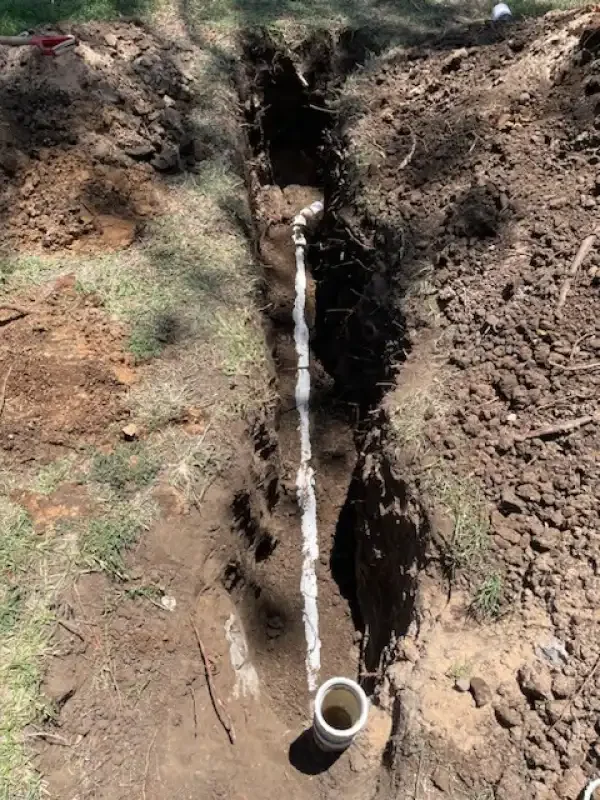
Out in the yard, replacing a sewer line means a trench. The pipe gets bedded, set to the right fall so waste keeps moving, joined, and tested before any dirt goes back.
Under the house is harder, because almost every house here sits on a slab. The choices are opening the floor along the line or tunneling underneath from outside. Opening the floor is often quicker when the line runs under a room that is already being remodeled. Tunneling keeps the inside of the house intact and makes sense when the run is under finished floors and cabinets. Which one fits depends on where the pipe goes, and the camera footage is what tells us that.
A cleanout, and the ground put back
A new line gets a cleanout where it leaves the house if there is not a good one already. It is a capped pipe that comes up to the surface so the next person, me or anyone else, can get a camera or a cable into the line without pulling a toilet. In older houses a missing or buried cleanout is common enough, and adding one is a small part of the job that pays off every time there is a question later.
Then the ground or the floor gets put back. In the yard that means backfilling and compacting so the trench does not sink after the first good rain. Inside, it means the slab gets patched properly. Putting it back is talked about before anything is opened, because nobody should find out at the end that restoring the floor was somebody else’s problem.
When to make the call
Two backups in a year on the same line is the point to stop clearing and look. A camera run tells you whether you have one bad joint or a whole pipe that is finished, and that answer is what the quote rests on. If it is one section, it gets fixed and you move on. If the run is done, you see the footage before anything is dug, and you decide with it in front of you.
How this work goes in town, from the camera to the cleanout, is on the Denton sewer line replacement page, and the full write up on the job is under sewer line replacement. When a drain is backing up right now, call (940) 231-5706 and you get me, not a dispatcher. Tell me how often it has happened and which fixture goes first.
Start with a phone call
Let me run a camera before you pay for another clearing, and you will see the pipe for yourself.